
CVA Benefit Assessor
Our CVA Benefit Assessor tool is used to assess the benefits and associated costs of any CVA initiative. We have a pre-configured tool for this purpose, but this may also be built out to meet a client’s particular requirements. The diagram below shows the primary components of our CVA Benefit Assessor:
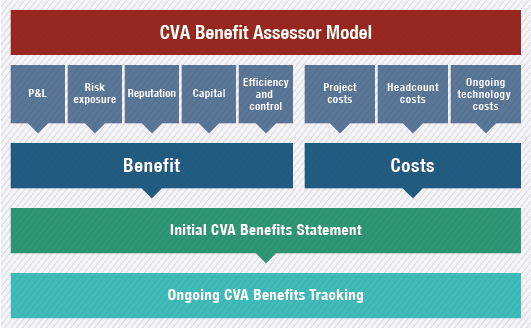
For each of the areas covered we have developed a range of metrics to assess the benefits and costs arising from the proposed programme of work:
| Area | Metrics |
|---|---|
| View full table | |
| P&L |
|
| Risk exposure | Expected change in counterparty credit risk exposures as a result of implementing a CVA process |
| Capital | Expected change in client’s economic and/or regulatory capital through appropriate hedging |
| Efficiency and control | Where further automation of a CVA process is being considered, the process and efficiency benefits of this automation is measured. e.g. in moving from manual pre-trade credit pricing to automated pricing processes |
| Reputation |
This is a more judgemental area in which we assess the likely impact on the client’s reputation from the perspective of:
|
| Project costs | We have standard project cost estimations for CVA projects based upon previous work. These can be used as a starting point and be built out for each client specific initiative |
| Ongoing technology costs | We have standard ongoing technology cost estimations for CVA infrastructure based upon previous work. These can be used as a starting point and be built out for each client specific initiative |
| Headcount costs | We have a headcount model for the estimation of the ongoing incremental business headcount which can be expected to arise from any process change |